What it is.
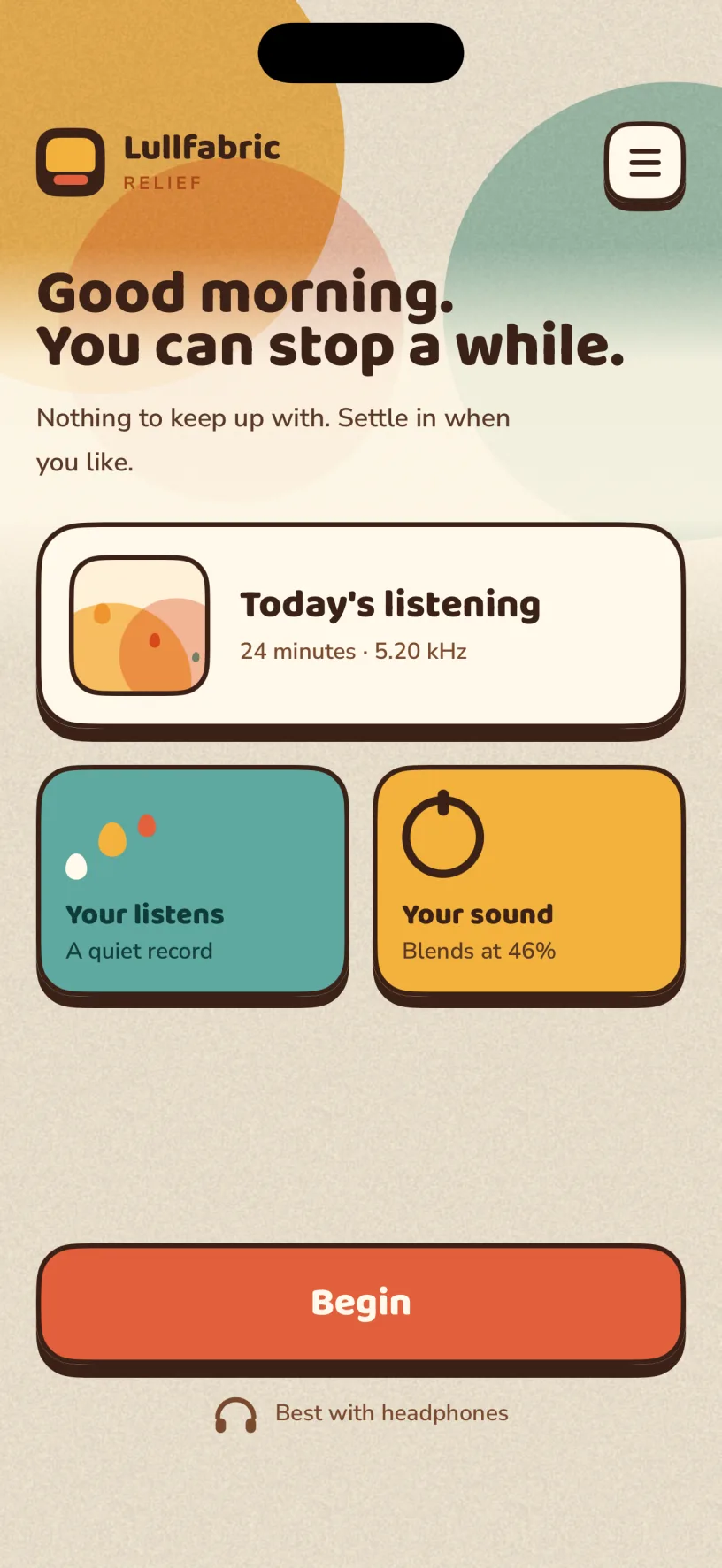
A calm, tactile app that learns the exact pitch of your tinnitus, finds the gentle level where sound sits alongside it rather than covering it, and builds your daily listen around both.
I built it for my own tinnitus, and I use it nearly every day. It is for anyone who would like something personal and honest, and who is happy to keep coming back over some weeks rather than hoping for an off switch.
How it works.
Four steps. The first two happen once, and you can redo them whenever you like.
1
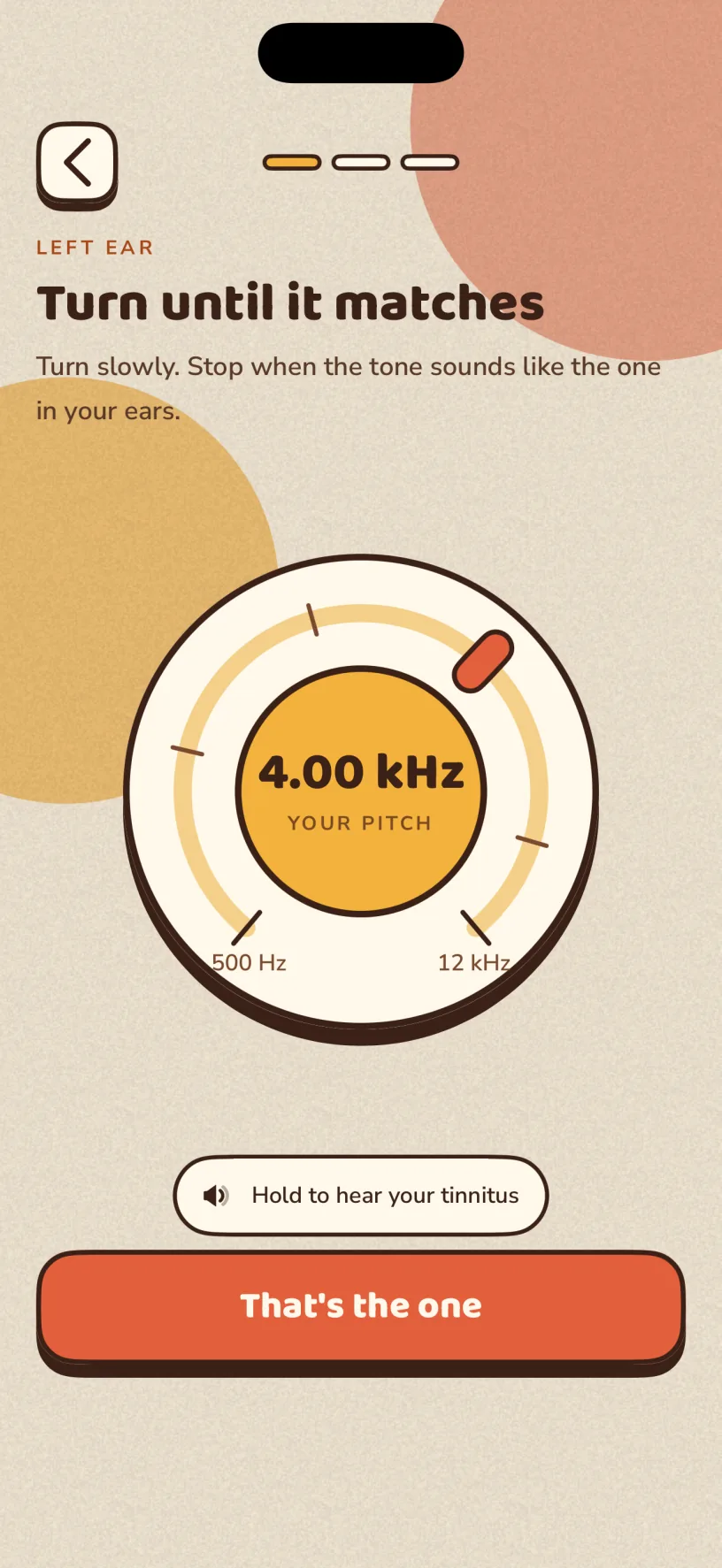
Find your pitch.
Turn the dial until the tone matches what you hear, then answer a few simple "which is closer?" questions. It checks the octave for you, because almost everyone lands an octave off at least once. Left and right ears are tuned separately, so one-sided tinnitus works properly.
2
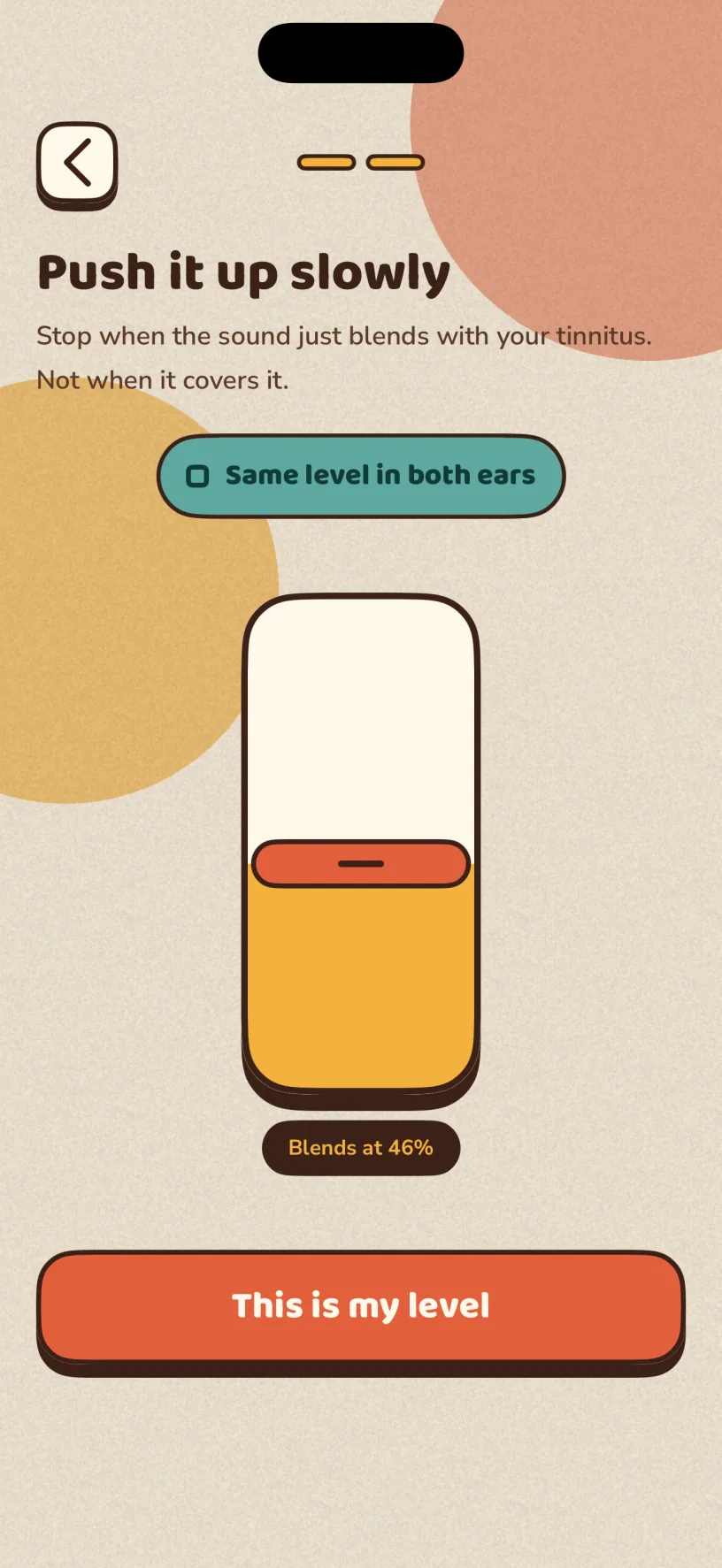
Find your level.
The sound rises slowly from silence. You stop it at the point where it just blends with your tinnitus, not where it covers it. That becomes a ceiling the app will not go above. Every session fades in gently, and nothing ever starts loud.
3
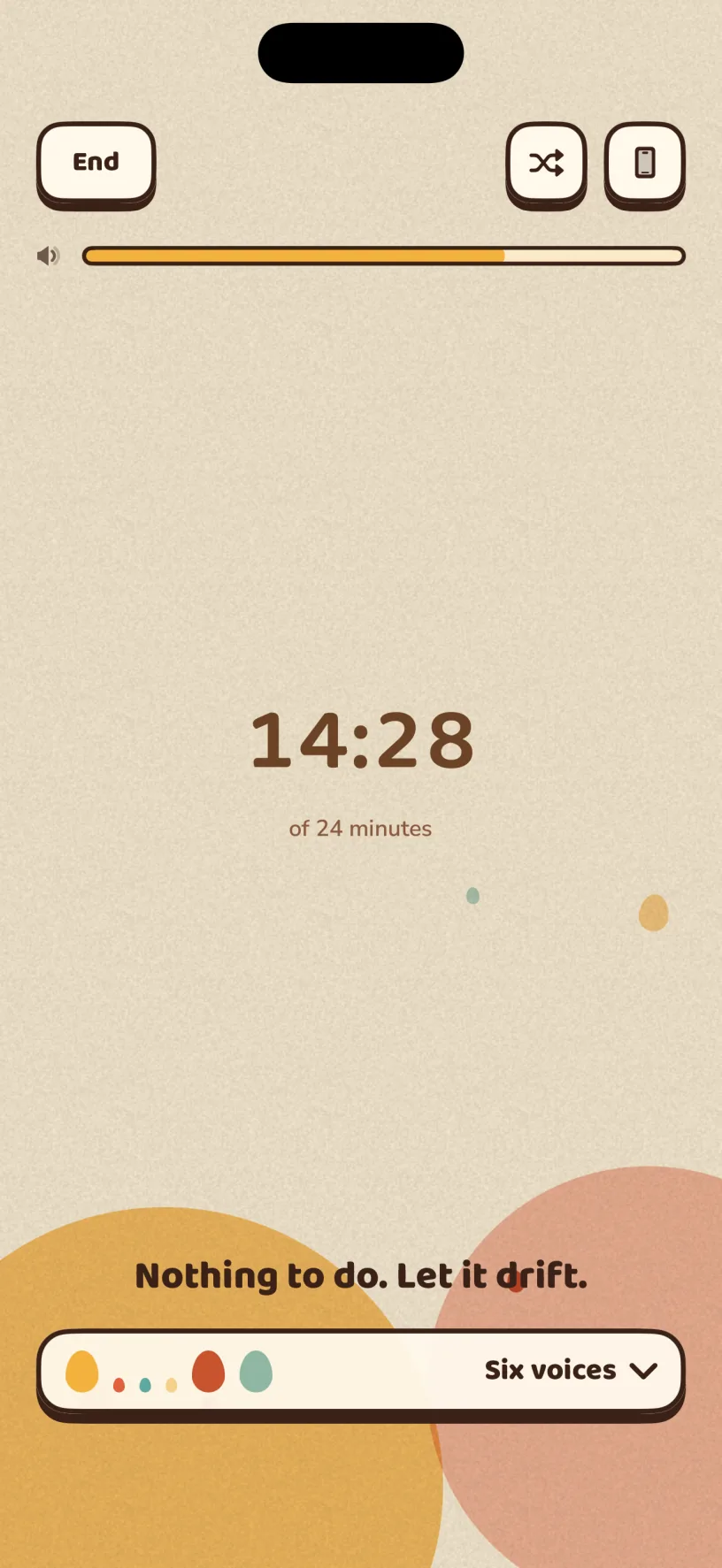
Listen.
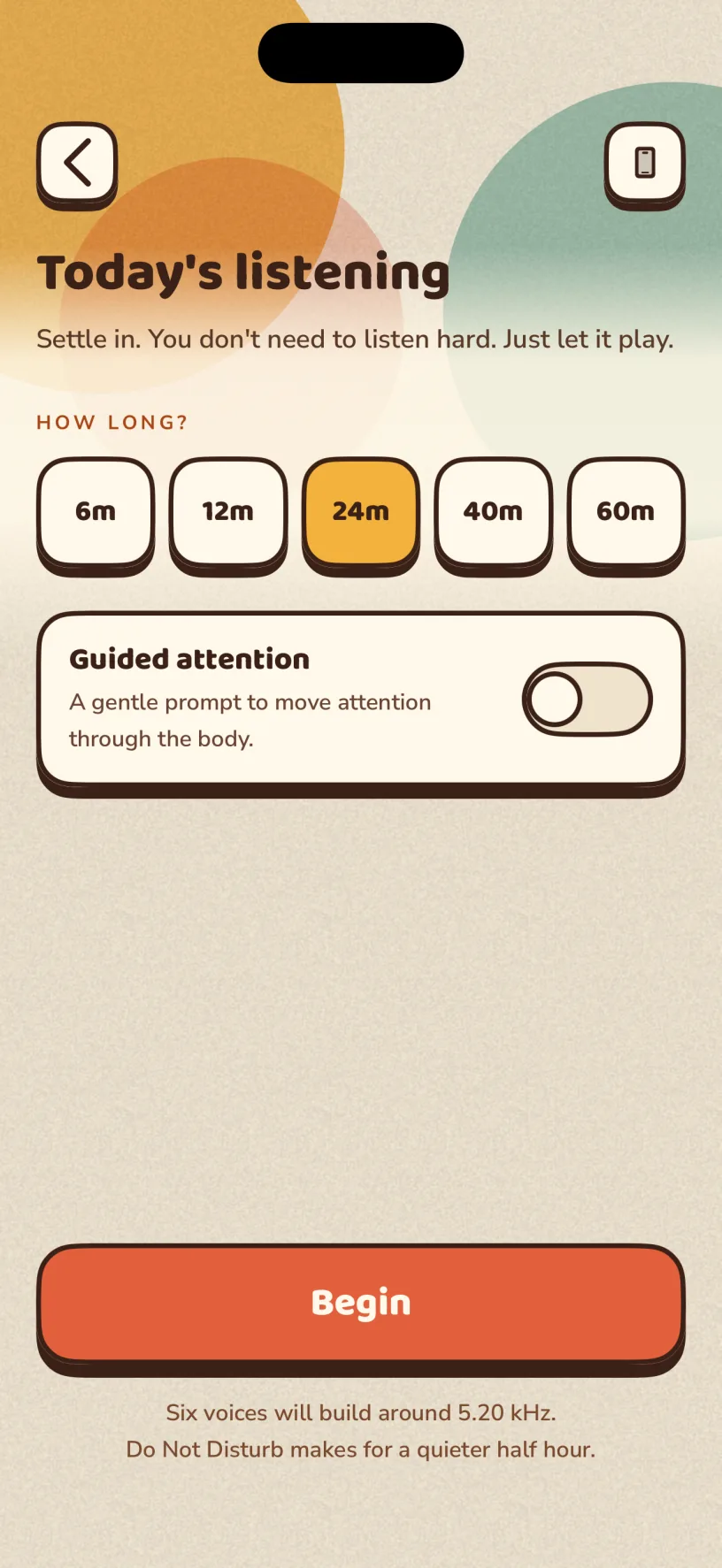
Six to sixty minutes, 24 by default. Warm music, composed fresh for every session by the generative engine, with therapy sound shaped right around your pitch. Nothing loops and nothing repeats. Put the phone down, lock it, close your eyes. It keeps playing.
4
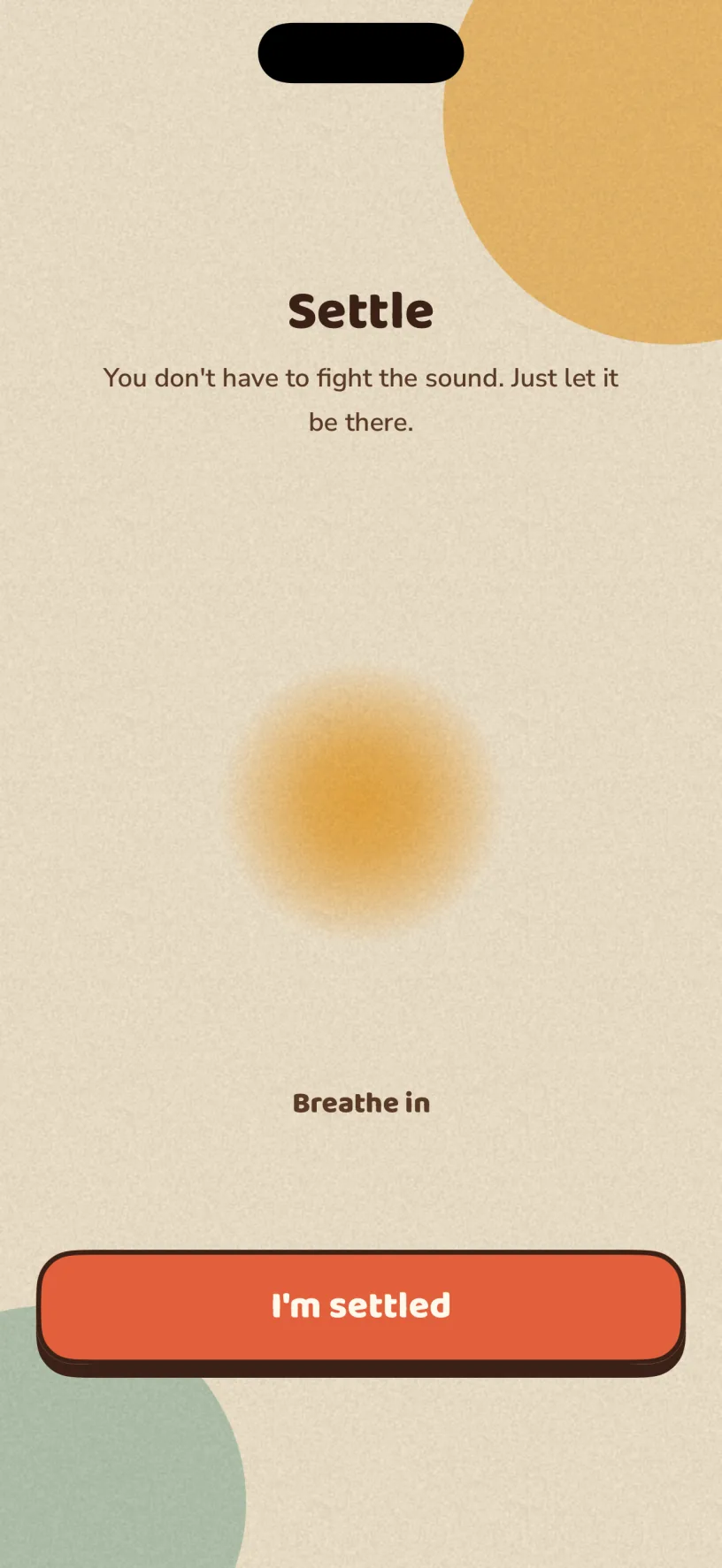
Settle.
An optional breathing wind-down, and an optional guided pass that moves your attention from the ear, through the body, and out to somewhere wider.
The guided pass matters more than it looks. Much of the better evidence in this area is not about the sound itself, but about your relationship with the sound.
What makes it different.
- Tuned per ear. Left and right have their own pitch and their own notch, so tinnitus in one ear is properly looked after.
- Notched, not masking. Your tinnitus stays gently audible underneath, which is the point. Nothing here is trying to drown it out.
- Composed fresh every session. There are no audio files in the app at all. A generative music engine writes every note in real time, so there are no seams, no repeats, and nothing to tire of.
- The width of the gap is yours. Narrow, standard or wide, depending on whether your tinnitus is one clear tone or a hiss you cannot pin down.
- Honest about the evidence, in the app. The safety notes and the research are one tap away in Settings, at all times.
What the research actually says.
Notched sound therapy works on a simple idea: rather than covering your tinnitus, remove a band of sound around its pitch and let the frequencies either side do the work. Those neighbouring frequencies stimulate nearby neurons, which are thought to gradually damp down the over-active ones. The founding study, published in 2010, found that after a year of listening, people reported quieter tinnitus and brain scans showed less activity in the region that codes their pitch.
That is only half of it, though. Tinnitus is as much about attention as it is about sound: the more of your attention it holds, the louder it seems. So the notch is carried inside warm, slow music rather than a band of noise, because something you genuinely want to listen to gives your attention somewhere else to rest. Some of the clearest evidence in this area is not for the sound at all, but for gently changing your relationship with it, which is what the guided attention pass and the breathing wind-down are there for.
The evidence for the notch itself is genuinely varied, and it is worth saying so plainly. A review of fourteen trials in 2025 found notched music beat ordinary music listening. A review in 2024, in the same journal, found no significant difference. Clinical guidance treats sound therapy as one reasonable option among several, and puts as much weight on attention and distress as on the sound itself. There is also some evidence that notching helps less if your tinnitus sits above about 8 kHz. Lullfabric tunes from 250 Hz to 14 kHz, so some people will be above the range where notching has been shown to help.
So here is the honest version. This may help, slowly, if you come back most days over some weeks. It may not. It is not a cure. What Lullfabric can offer is a sound that is built carefully, tuned to you, and gentle enough to live with.
"I had very mild tinnitus for years. Then Covid hit and it got much louder, mostly in my left ear. Most of the time I cope. But there are moments when it is overwhelming, and I wanted something to reach for in those moments that was genuinely relaxing and might also be doing some good. It is not a cure. There is no cure. But it is some relief."
The references, in full
- Okamoto H, Stracke H, Stoll W, Pantev C. "Listening to tailor-made notched music reduces tinnitus loudness and tinnitus-related auditory cortex activity." PNAS 2010;107(3):1207 to 1210. Read it
- Stein A, Engell A, Junghöfer M, et al. "Short and Intense Tailor-Made Notched Music Training against Tinnitus: The Tinnitus Frequency Matters." PLOS ONE 2011;6(9):e24685. Read it
- Jiang W, Zheng Y, Zheng C, Chen R, Li B. "The efficacy of notched music therapy vs conventional music therapy for chronic subjective tinnitus patients." European Archives of Oto-Rhino-Laryngology 2025. Fourteen trials, 793 patients. Read it
- "Efficacy of tailor-made notched music training (TMNMT) in the treatment of tinnitus." European Archives of Oto-Rhino-Laryngology 2024. Seven trials, no significant effect. Read it
- LUCID trial, "Assessment of a Novel Sound-based Treatment for Managing Distress Related to Tinnitus", ClinicalTrials.gov NCT06083519. A protocol, not a result. Read it
- "Clinical Practice Guideline for Management of Tinnitus: Recommendations From the US VA/DoD Clinical Practice Guideline Work Group." JAMA Otolaryngology, Head & Neck Surgery 2025. Read it
- McKenna L, Marks EM, Hallsworth CA, Schaette R. "Mindfulness-Based Cognitive Therapy as a Treatment for Chronic Tinnitus: A Randomized Controlled Trial." Psychotherapy and Psychosomatics 2017;86(6):351 to 361. Read it
None of these researchers have heard of Lullfabric, and none of them endorse it.
Coming back matters more than listening longer.
The research points at consistency rather than intensity. Studies tend to land around 24 minutes a day, with any benefit tied to listening on most days rather than to long sessions.
So the app suggests 24 minutes, never goes beyond 60, and quietly notices when you come back. There are no badges and nothing to lose. If you miss a week, it says welcome back.
Pay once, and it is yours.
There is nothing to subscribe to, no account to make and no password to remember. There is no advertising and no analytics, and the app never contacts a server, so there is nothing to send and nothing to intercept. Your pitch, your level and your session history stay on your phone, and Settings has a button that hands you all of it as a file, and another that deletes it for good.
What Lullfabric can and cannot do.
Lullfabric is a wellness tool, not a medical device. It is not intended to diagnose, treat, cure, or prevent any disease or condition, and is not a substitute for professional medical advice, diagnosis, or treatment. Tinnitus can occasionally signal a condition that needs attention. Always consult an audiologist or doctor for tinnitus that is new, sudden, one-sided, pulsing (in time with your heartbeat), accompanied by hearing loss or dizziness, or changing quickly. Listen at a gentle, comfortable volume; stop if you feel any discomfort. Results, where people experience them, are typically modest and build slowly over weeks.
£3.99 / $3.99, one payment.
The other apps in the Lullfabric suite